Pre-Race Briefing

Plan the fuel before
the effort gets hard.

Build road and trail fueling plans with carbs/hr, fluid/hr, sodium/hr, refill needs, weather context, and prep cost.

Nakamuve Race Fuel Brief
v1.2
Merbabu Trail Simulation
50K · +3200m · 11h30m · exposed
Grade B+
Carbs/hr
72g
Fluid/hr
610ml
Sodium/hr
840mg
Refill Stops 6–7
Limiter Hydration logistics
Prep Cost Rp 944.600
High refill dependency — verify aid station spacing before race day
Race Conditions Trail Ultra · 50K · +3200m
Weather
29°C · humid
exposed terrain
Sweat Rate
1.1L/hr
elevation-adjusted
Fluid Need
7.4L
11h30m projected
High refill dependency Hot-weather hydration load Unsupported section ahead

Where long-run fuel plans fail.

Most runners discover these gaps mid-race, not before.

Carb target exceeds gut tolerance — 90g/hr looks good on paper but causes GI distress after hour 3 in humid conditions
Fluid plan depends on unreliable aid stations — assumed 5km spacing doesn't match actual 8–12km course layout
Carry capacity insufficient for projected heat — 1L vest cannot cover 7.4L fluid requirement across exposed terrain
Sodium strategy inadequate for humidity — 500mg/hr fails when sweat rate exceeds 1L/hr in 29°C conditions
Refill timing leaves unsupported gap — 14km between stations with no natural water source and rising temperature

Race conditions & logistics.

Weather, terrain, aid station layout, and carry capacity determine whether a fueling plan is executable.

29°C · Humid · Exposed Terrain · +3200m
Projected fluid need: 7.4L · Carry: 1L
Longest unsupported: 14km
Environmental Conditions Trail Ultra · 50K
Weather
29°C
humid
Heat Load
High
exposed terrain
Sweat Rate
1.1L
per hour
Elevation
+3200m
gain
Hydration Operations carry: 1L soft flask
Capacity
1L
Required
7.4L
Deficit
6.4L
Refills
6–7
⚠ Fluid capacity insufficient ⚠ Refill reliability critical Aid station spacing: 6–14km
Unsupported Section gap between stations 2–3
Longest unsupported section: 14km — no planned water source. At 1.1L/hr sweat rate, 1L carry capacity is insufficient to cover this segment. Upload route data to verify aid station locations or adjust refill strategy.
Est. crossing time 2h–2h30m Fluid needed ~2.5L Available 1L
Fuel Loadout example: 50K trail
Gel x3 DIY Mix x2 Banana x1 Rice ball x2 Sodium cap x4 Soft flask 500ml Rp 944.600 total

All items fit within estimated carry weight. Adjust quantities based on aid station availability and personal preference.

Operational planning modules.

Each system evaluates a specific race-prep variable with real data from your effort.

Fuel Strategy Evaluation B+
CARBS/HR
72g
FLUID/HR
610ml
SODIUM/HR
840mg
⚠ Carb target approaches gut tolerance
Carry & Refill Logistics High refill dependency
CARRY
1L
REQUIRED
7.4L
DEFICIT
-6.4L
REFILLS
6–7
⚠ Hot-weather hydration burden
Aid Station & Refill Planning

Maps aid station locations against carry capacity, elevation profile, and weather to identify unsupported gaps.

+3200m gain · exposed 14km unsupported
Fuel Inventory & Cost
Gel x3 DIY Mix x2 Banana x1 Sodium cap x4 Rp 944.600 total

Turn the plan into a timeline.

A fueling plan is only useful if you know when to execute each step. Nakamuve converts your strategy into an hourly timeline you can follow or hand to crew.

N Sample — Trail Ultra 50K
11H30M
00:00 Start hydrated

500ml water + 200mg sodium pre-load

00:35 Gel + water

1 gel (25g carbs) + 150ml water

01:10 Banana + sodium

Half banana + salt tab (250mg sodium)

02:00 Refill point

Fill bottles, assess condition, adjust plan

03:30 Caffeine starts

Caffeine gel + water, increase sodium

04:45 Aid station dependency

Next station at 8km — ration fluid

Race brief export.

Export compact race briefs showing fueling strategy, hydration limitations, refill dependency, and preparation cost. Useful for crew handoff, drop bag labeling, or pre-race review.
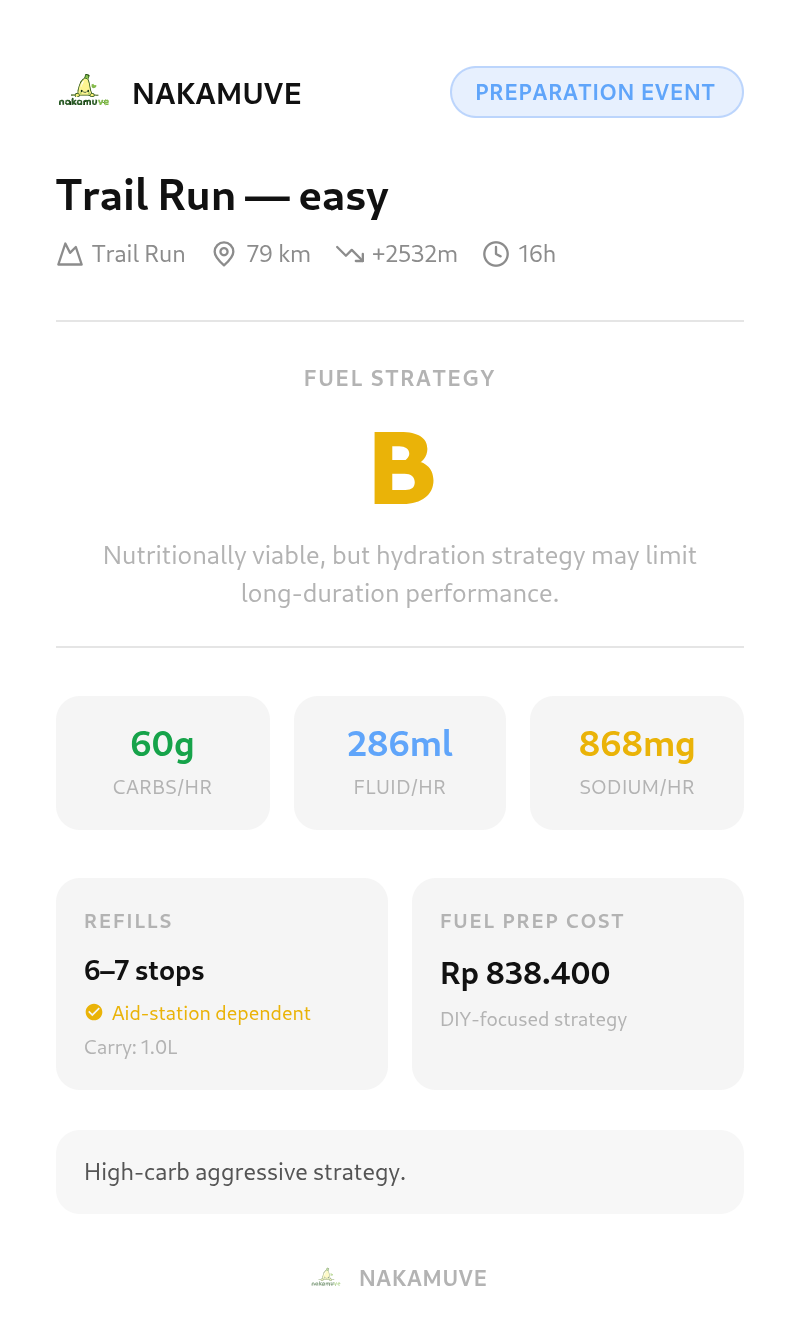
PDF brief GPX stations strategy card post-run log
Fuel plan summary example

Not a training plan.
Not a calorie tracker.

Training tells you what to run. Nakamuve helps you decide what to carry, when to eat, when to drink, and where the plan breaks.

Nakamuve

  • Fuel strategy
  • Hydration logistics
  • Sodium planning
  • Carry / refill feasibility
  • DIY + local fuel support
  • Exportable race brief

Not Nakamuve

  • Training plan generator
  • Calorie diary
  • Social feed
  • Weight-loss app
  • In-run logging

How it works

From effort selection to post-race debrief in six deliberate steps.

01

Choose the effort

Select distance, elevation, surface type, and expected pace for your upcoming run, race, or ultra.

02

Add conditions

Set temperature, humidity, altitude, aid station spacing, and the fuel sources you plan to use.

03

Build the fuel plan

Get carb, hydration, and sodium targets per hour, tailored to your specific effort and conditions.

04

Check feasibility

Verify your carry capacity against refill points. See exactly where your plan works and where it breaks.

05

Export and execute

Export PDF strategy cards, GPX with aid station annotations, and shareable fuel summaries.

06

Debrief afterward

Log what actually happened. Refine your strategy for next time with real execution data.

One-time upgrade for serious prep.

Rp100,000 · $10 · lifetime

GPX planning with elevation-aware fueling
Weather-adaptive recommendations
Hydration and refill feasibility checks
Exportable PDF, GPX, and shareable race briefs

Stop finding out too late.

Know the fueling gaps before the long run exposes them.